

For the second event of M.Bassy’s 2025 interdisciplinary music series »Composing While Black. Afrodiasporic New Music Today«, co-curated by the musicologist, author and saxophonist Dr. Harald Kisiedu, we welcomed the French-German scholar and dramaturge for music, opera, theatre and performance art Dr. Dr. Daniele G. Daude and three musicians – Neneh Sowe, Yassin Sowe and Eurico Mathias – of the classical string ensemble The String Archestra from Berlin at M.Bassy e.V. to perform selected works by Ayanna Witter-Johnson, William Grant Still and Fela Sowande.
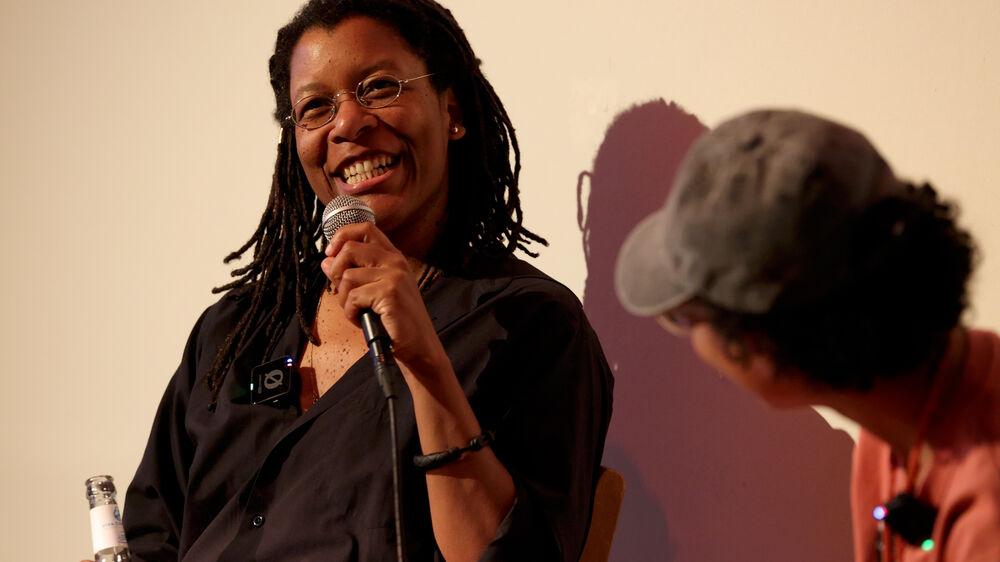
Daniele G. Daude founded The String Archestra in 2016 aiming to perform works by BIPoC composers which have completely disappeared both from canonical music historiography and from a standardized concert repertoire. After the live-performance at M.Bassy Daude and Kisiedu dived into a conversation moderated by Jumoke Olusanmi.
What I love about the music by Ayanna Witter-Johnson is how she is able to use the best of many influences to create new musical worlds. I also like how she writes, making each voice important and specific on the one hand but also essential part of a whole in the same time. She is a British composer who is paying homage to Jamaican heritage in some of her compositions like in ,Mento Mood' or ,Brandle Riddim' but is also open to many worlds as you hear in her music.
Excerpts from the conversation:
Jumoke Olusanmi:
You two also teach music. How do you reach a young audience? How do you train people to listen to what you are interested in?
Daniele G. Daude:
As Director of The String Archestra I always give a short introduction to the composers before the concerts. Since we are rooted in community work, it is basically our family and friends who are coming. I am not educating the audience but sharing knowledge and silenced her*/stories. It is not about education but about building communities from different heritages and experiences and coming together for discussions. When I teach music history or analysis at university, this is a very different situation. Students come with some historical knowledge and understanding and also to learn something new. My job as a teacher is not only to fill students with knowledge but also to activate them to question their own knowledge and using it for their musical practice. For many of them they hear about Black composers, Indigenes composers and composers of Colors from 18th, 19th and 20th century for the very first time. I draw attention to this phenomenon by asking how knowledge has been created in German musicology since 1945? What was the selection's criteria to archives composers and erase others? Then we can start having interesting conversations.
Harald Kisiedu:
I think that, at times, teaching is also about helping students unlearn certain assumptions. Many students arrive with preconceived notions or misconceptions about music — especially Afrodiasporic music. But this music did not emerge in a vacuum; it exists within broader historical, political, and cultural contexts. I often feel that the history of music is inseparable from the history of ideas — it is, fundamentally, a form of intellectual history.

Jumoke Olusanmi:
While collecting the essays for »Composing While Black: Afrodiasporic New Music Today«, who did you imagine as the primary audience for the publication? Who did you feel you were gathering and assembling these texts for?
Harald Kisiedu:
With this collection of essays, we did not only want to reach colleagues within the field of music, but rather conceived it as a kind of ,Wegweiser' for cultural institutions, curators, journalists, teachers, and professors. The idea was to shift and expand the discourse surrounding music by creating a space for Afrodiasporic perspectives, experiences, and forms of knowledge that have long been marginalized within contemporary music institutions and academia.

Our Guests:
Dr. Dr. Daniele G. Daude is a French-German scholar and dramaturge. After graduating with honors in violin and chamber music from the Conservatoire National (Aubervilliers region), Daniele G. Daude studied musicology in Paris and opera direction at Hanns Eisler. Daniele G. Daude completed their first doctorate in theatre studies at the Freie Universität Berlin in 2011, specializing in performance analysis, and their second doctorate in musicology at the Université Paris 8 in 2013, specializing in opera analysis. Since 2008 Daniele G. Daude has been teaching at German and French universities. 2013-2015 Daniele G. Daude is Visiting Professor of Performing Arts at the Campus Caribéen des Arts (Martinique). 2016-2020 Daniele G. Daude is Maître* de Conferences for Aesthetics and Philosophie. Daniele G. Daude founded and leaded the community Choir Com Chor Berlin (2013-2023) and founded The String Archestra (2016-) to perform works by Black, Indigenous and PoC composers that have been erased from a canonical musical historiography and a standardized concert repertoire. In 2021, The String Archestra received the TONALi Award for its longstanding work. Daniele G. Daude has been working as a lecturer, and dramaturge for concert, opera and theatre since 2016, currently teaching at Berlin Universität der Künste.
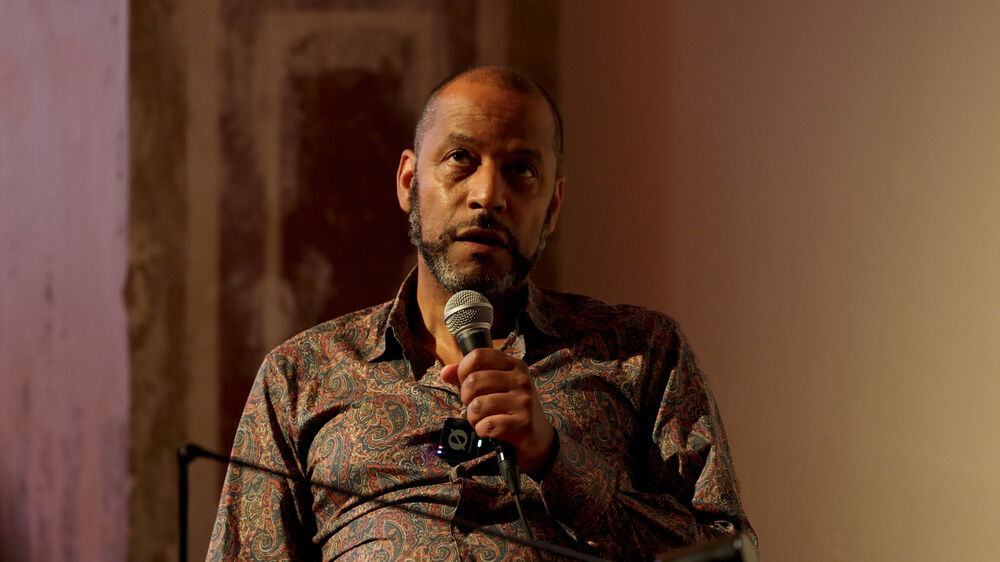
Harald Kisiedu is a historical musicologist, author, and saxophonist who received his PhD in historical musicology from Columbia University. He also holds a graduate degree in political science and German studies from the University of Hamburg. His research interests include Afrodiasporic classical and experimental music, jazz as a global phenomenon, improvisation, music and politics, and Wagner. Kisiedu’s writings have appeared in the WIRE, Grove Dictionary of American Music, Critical Studies in Improvisation, Journal der Künste, and Darmstädter Beiträge zur Jazzforschung a. o. He has taught at the University of Music and Theatre Felix Mendelssohn Bartholdy Leipzig, the Musik-Akademie Basel, the University of Applied Sciences Osnabrück, the British and Irish Modern Music Institute Hamburg, and the Darmstadt Summer Course. As a saxophonist, Kisiedu has performed with Branford Marsalis, George Lewis, Henry Grimes, Jean-Paul Bourelly, and Hannibal Lokumbe and has recorded with the New York-based ensemble Burnt Sugar, the Arkestra Chamber led by Greg Tate. He is the author of »European Echoes: Jazz Experimentalism in Germany, 1950-1975« (Wolke) and the co-editor with George E. Lewis of »Composing While Black: Afrodiasporic New Music Today« (also Wolke Verlag).
ORDER THE BOOK »Composing While Black. Afrodiasporic New Music Today«
We would like to thank the Musikstadtfonds of the Ministry of Culture and Media Hamburg as well as by the GVL for their support of the interdisciplinary music series and furthermore, the Deutsche Stiftung für Engagement und Ehrenamt, whose 100xDigital funding program made it possible to expand our digital archive with this journal entry.