


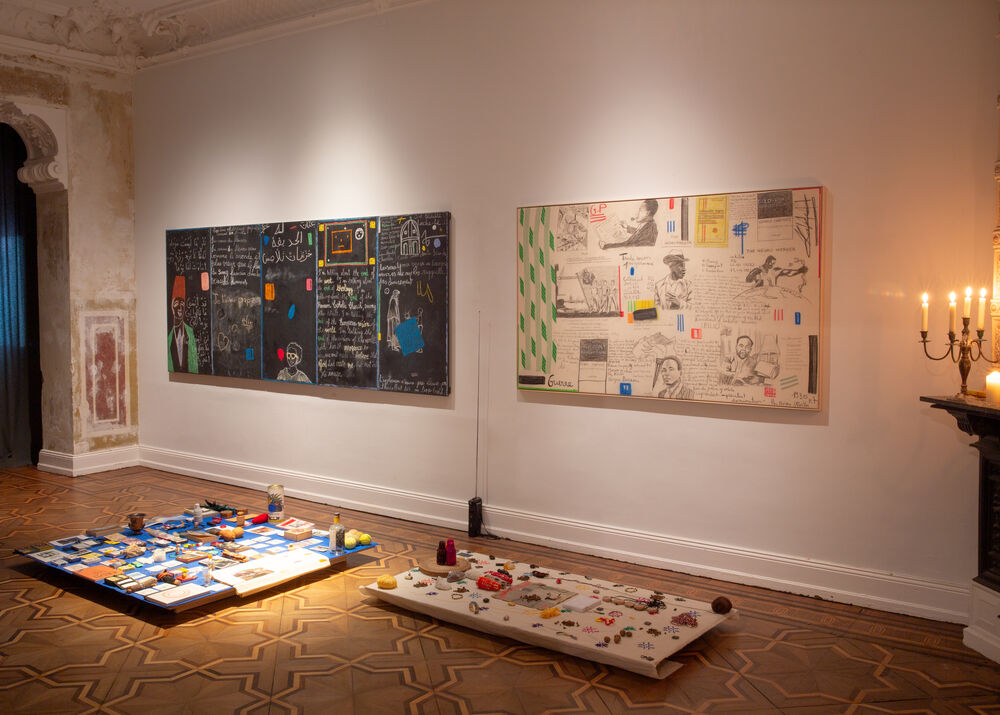
The exhibition project »Unity in Diversity: Pan-African Art Practices of Collective Care« featured multimedia installations, objects and video works by Larry Achiampong, Sammy Baloji, Hamedine Kane & The Otolith Group (Oct 12 – Dec 6, 2025) exploring the connection between the Pan-African movement and art as a means to explore African and diasporic identities and heterogeneities and to pave the way for a decolonial future. Hamedine Kane from Dakar was our artist-in-residence and engaged for the opening into an artist talk with Larry Achiampong from London.
Accompanying the exhibition M.Bassy hosted a three-day thinking lab (Nov 6 – Nov 8, 2025) entitled »Pan-Africanism: Past – Present – Future« with the artist, filmmaker, musician and lecturer Larry Achiampong, the actress and filmmaker Aïssa Maïga, the multidisciplinary artist and entrepreneur Teemour Diop Mambéty & the writer, archivist and activist Attillah Springer. The thinking lab aimed to provide a platform for experts and cultural figures from various disciplines to exchange ideas and discuss Pan-Africanism, its history, current significance, and future prospects. Furthermore, it aimed to encourage networking and collaboration to develop concrete plans for the future. It culminated in a public panel conference on November 8, where pan-African core messages, demands, and visions were discussed with the audience, who formulated strategies for a solidarity-driven future in a globalised world.

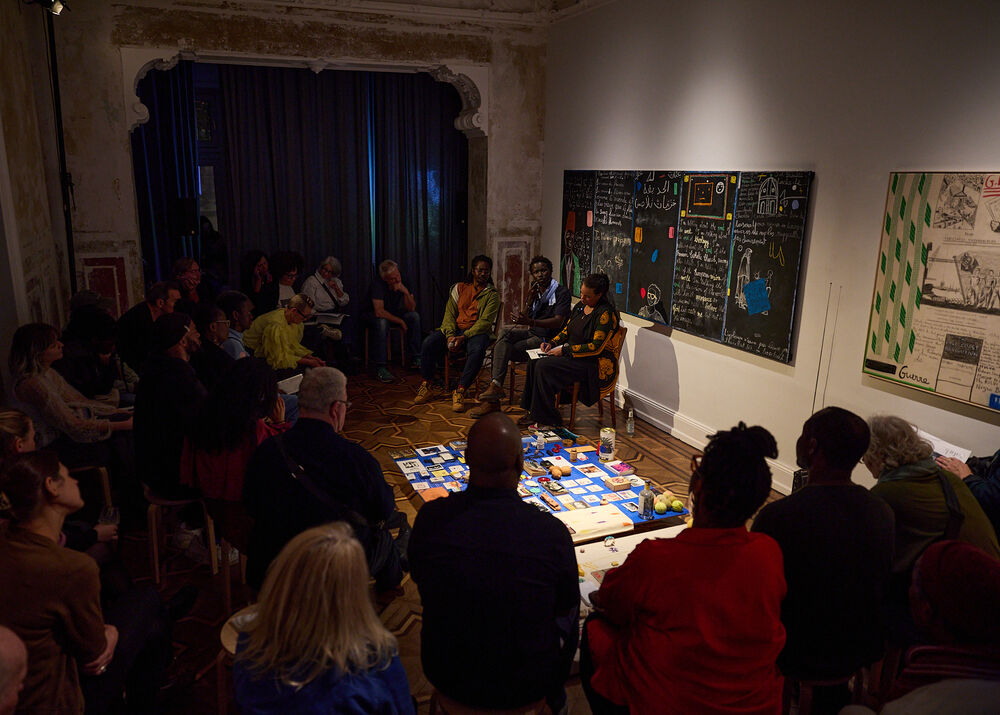

Excerpt from the accompanying panel conference:
We are all second- or third-generation Pan-Africanists, meaning that our families were at the forefront of Pan-Africanist thought and action in different parts of the world.
Attillah Springer:
We are all second- or third-generation Pan-Africanists, meaning that our families were at the forefront of Pan-Africanist thought and action in different parts of the world. One of the things that emerged from the discussions (during Thinking Session I and II) this week was how in different but also in similar ways our families were all involved in the ideas and the work of Pan-Africanism in their lives.
Aïssa Maïga:
I feel very moved, because throughout all our conversations, I felt that something significant was happening, something that people before us have been dreaming of: the reconnection of the African diaspora. I know that I was born into a Pan-African family. As a child, I had no idea what that meant. Often, my father and his friends and uncles would gather at home and argue and talk passionately. I felt that each of them wanted to defend their own point of view or idea. I wish I had had the chance to get to know my father better, as he passed away when I was eight. Although I was part of the conversation, as I was there with them and they were happy for me to be there, I still feel frustrated because it feels like something was taken away from me.
My journey as a child of a Pan-Africanist is the journey of loneliness and sometimes of connection to try and understand this legacy. My father was a journalist. I'm lucky that he was a journalist as I have been able to collect all the articles he wrote while based in Paris and on the African continent. This legacy doesn't belong to me alone, but to anyone, anywhere, not only to the Black diaspora. It's a legacy for the whole world. It's not like a mausoleum; it is something very vivid because their school of thought was very modern and it still resonates today.
My journey as a child of a Pan-Africanist is the journey of loneliness and sometimes of connection to try and understand this legacy. It's a legacy for the whole world.
Attillah Springer:
Teemour, one of the things that we talked about was the sense of dignity instilled in you by your father. Could you share with our audience how his sense of dignity embodies your Pan-Africanism?
Teemour Diop Mambéty:
My dad was awarded some sort of honour, a cultural knighthood, in Burkina Faso. After his speech he said, "I am honoured, but in this particular case, you would have to shake the hand of a traitor, and I cannot do that. Hence, I cannot accept it. But thanks for the honour." This is still one of the greatest lessons I have learned, and it translates into my work to this day.
How does it translate in our everyday lives? If everybody walks out of here with a new perspective and a new perception, it will be a success, because everybody sees the world differently and has a different view of Africa. If you walk out of here with a different perception of yourself - if you are African - or a different perception of yourself and of Africans - if you are not African – it is a success; that is Pan-Africanism.
Attillah Springer:
Larry, perception is a theme that emerges strongly in your work. Could you talk to us about your notions of perception and time, and how they influence your daily Pan-Africanist practice?
Larry Achiampong:
I see myself as part of different generations – both those who came before me and those who will come after. I am a parent in the sense that I have two children, but also in the sense that I mentor other people. I talk to my kids about the struggles and the fights that they will face - in the same way that Frantz Fanon (1925-1961; was a psychiatrist, political philosopher and Pan-Africanist from the French colony of Martinique) talks about them.
Art, as a space from which pockets of freedom and dissemination can emerge, is really at risk of being taken away from the working classes. I come from a working-class background. I experienced poverty as a kid. This, if I may be blunt, is real to me. I approach it with the strength and the energy that my mom has breathed into me – my mom is one hell of a fearless person. She has stared down the barrels of soldiers' weapons during different military coups. These things are – she is - not well known in popular culture. But she has told me and my siblings: “One day, you will tell our stories!“
Attillah Springer:
Personally, I am concerned about how much of the conversation around culture and cultural work is dominated by the issue of funding. It is dominated by your positionality as opposed to your work. The conversation around work focuses solely on making artists more efficient money-makers, rather than more efficient revolutionaries or more efficient agents of change or more efficient transformers of communities.
I often say that being African is like a religion. It involves both belief and practice. When you practice being African, you must be in touch with Africa.
Teemour Diop Mambéty:
I often say that being African is like a religion. It involves both belief and practice. When you practice being African, you must be in touch with Africa. This is my personal perspective - I'm not trying to teach anyone a lesson. I have seen sometimes people spend years abroad, then suddenly announce, “Oh, I am going back for a few months”, as if they were returning to a place where everybody was just waiting passively for some prophetic traveller to come back and reconnect with their roots. But it doesn't work like that!
This is my way of practicing being African: This is how I practise being African: It's about creating jobs out of opportunities that you initiated or sought out. That doesn't make me a prophetic traveller — I'm just one of many.
I attach that to many things. Take the way we make films, for example. There must be something in it for the people! The financing paradigm often goes one way. Wesley Snipes (b. 1962; American actor) once answered a question I asked at a similar event. He said: „You know what? Whoever puts food on the table makes the rules in the house.“ And I thought, “Shit, we better have a house, man!”.
Aïssa Maïga:
When I first started out as an actor in Paris, it all began with a dream. I wanted to embody characters, tell stories, and change the world. I was quite young and quickly realised that all the roles I was offered were similar: a young, mistreated black French girl. This was not my personal experience. This led me to read a lot of books. What people in the industry told me to justify this was: “You're an immigrant, or the daughter of an immigrant who has just arrived.” And: “French people are not ready to tell stories that are different to that.” This was completely false. In fact, I discovered that Black bodies had been represented on stage in France, in Paris, in theatres as early as the 15th century, and that these theatres still exist today. It helped me to see beyond the situation and realise that it wasn't my problem. It was their problem, because they didn't know their own history.
It was my father's courage that gave me the strength to go through this. He was passionate about the advancement of the African continent. He travelled widely and wrote extensively about South Africa, Zimbabwe and Ghana. At some point he met somebody who would become his comrade and friend: Thomas Sankara (1949-1987; was a Burkinabé military officer, Marxist and Pan-Africanist revolutionary who served as the President of Burkina Faso from 1983, following his takeover in a coup, until his assassination in 1987). Discovering this as a young adult was both humbling and empowering. It was humbling because I knew I had a strong background, although I was a French Black girl in Paris. There are countless examples of courage in Black history. We have all seen ordinary people make tremendously courageous choices in the face of enormous difficulties. My inspiration comes from these examples, both from significant figures in Black history and from the people I met when travelling to visit my family in Mali, Senegal and France.
Holding my father's story also makes me feel strong because there's no way I can capitulate. I may be tired and sometimes I can be desperate, and I may feel fear, but I know that I will never give up.
Attillah Springer:
You talk so passionately and eloquently about your father's story, and we all have moments in our collective histories involving physical violence. One thing that has come up over the last couple of days is the notion of walking around with a target on your back simply for being Black. For Black men, it's one kind of violence, and for Black women, it's another, even more sinister kind. Larry and I have been talking about holding onto ancient practices. I am a stick fighting practitioner, a combat style originating in Trinidad and brought there by enslaved Africans. Larry, I'd like us to discuss how violence is connected to notions of Pan-Africanism.
In my career, I've realised that those with higher privileges are further away from certain aspects of violence, right?
Larry Achiampong:
In my career, I've realised that those with higher privileges are further away from certain aspects of violence, right? The violence that my son and daughter face is different, and they have their own journeys in which they will inherit what's going on. This is why I take my daughter to karate every week. It's not just about whether she can defend herself if she's in school and someone's giving her trouble. I've spoken to some parents as well, and they're like, “Isn't that a bit too violent?”, or, “Aren't you turning that person into a bully?” No, because you're teaching them an understanding of justice and their own dignity, which you can't always find in textbooks.
But where are we going beyond that? In terms of my work, I ask myself: How am I working behind the scenes? How am I using my time to listen to others? How can I be there and be present? I can't be everywhere. Ultimately, I'm only human, but what can I do with my own bodily resources?
Attillah Springer:
This is how our days have been: thinking deeply about what Pan-Africanism means in practice for us. Thank you for this special week — it has been a pleasure!
Dive deeper into Pan-Africanist though listening to the four single podcast episodes with Larry Achiampong, Aïssa Maïga, Teemour Diop Mambéty & Attillah Springer:
M.Bassy Podcast: Episode 7 – 10 coming soon!
larryachiampong.co.uk
instagram.com/aissamaiga
instagram.com/teemourdiopmambety
attillah-springer.com
We would like to thank the Claussen-Simon Foundation, the ifa - Institute for Foreign Cultural Relations, the Liebelt Foundation, the BKM - Hamburg Ministry of Culture and Media, and the ZEIT STIFTUNG BUCERIUS for their funding and support of the project and furthermore, the Deutsche Stiftung für Engagement und Ehrenamt, whose 100xDigital funding program made it possible to expand our digital archive with this journal entry.